
Forty Years in Search of Sanchin
A Journey Beyond Technique, Toward Wholeness.
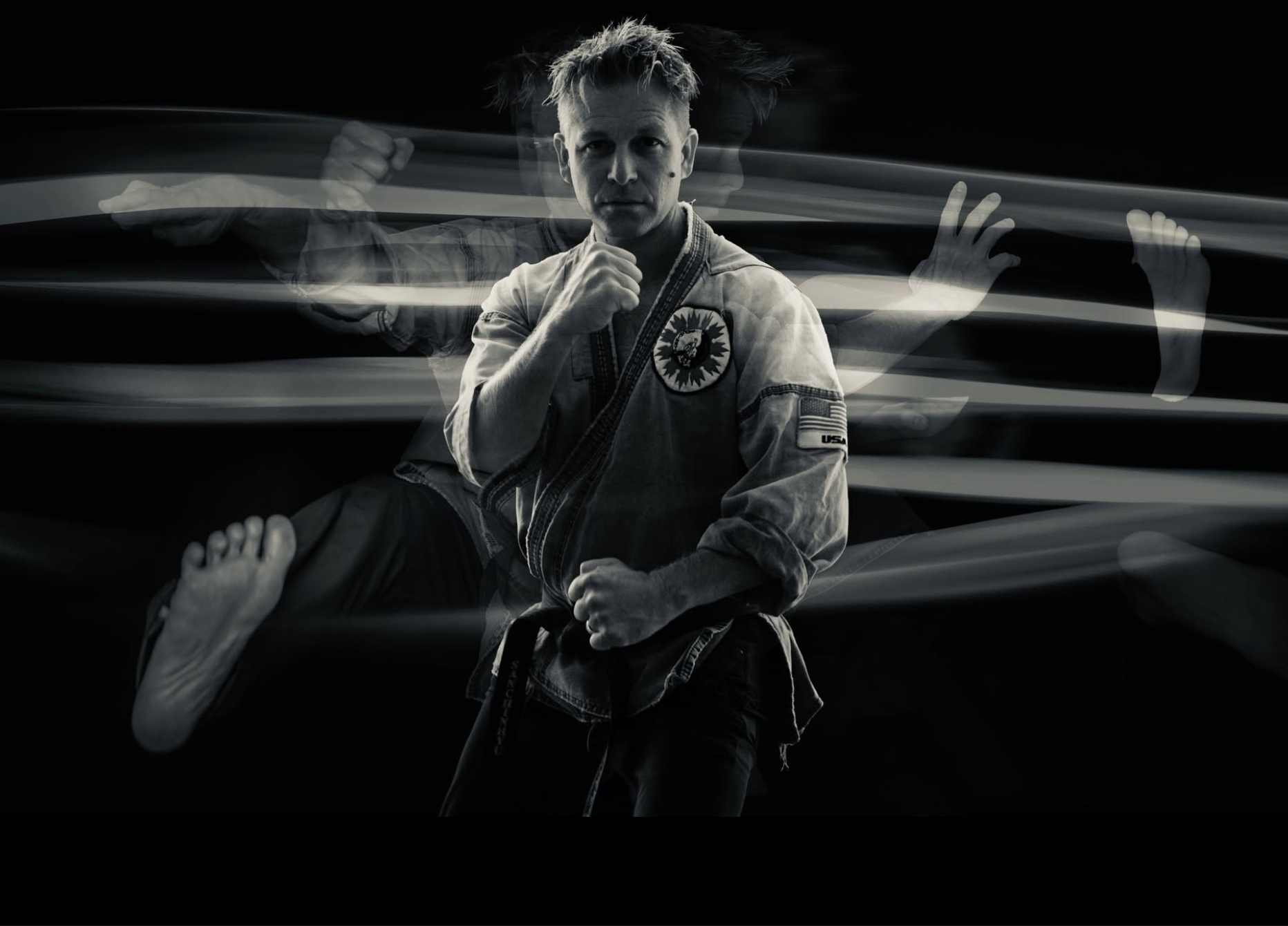
When I was a little boy, I didn't begin studying martial arts because I wanted to become a warrior.
I began because I was afraid.
I grew up in an alcoholic home marked by emotional instability, verbal abuse, and trauma. Like many children raised in those environments, I learned to become hypervigilant. I learned to read a room before I entered it. I learned to anticipate danger before it arrived.
School wasn't much safer.
I was bullied relentlessly.
There were days when other kids would get off the bus at my stop simply to beat me up. I would spend the entire school day wondering how bad it was going to be when the final bell rang.
I remember another day after gym class when someone took all of my clothes and threw them outside. I had to walk out of the locker room in my underwear to retrieve them while everyone laughed.
Humiliation has a way of shaping a young person.
Like so many kids searching for safety, I found martial arts.
I first studied Judo, then Taekwondo. Around the age of fifteen, I began training in an Okinawan-based system of karate that was founded in the United States. I had no idea then that I was beginning what would become a lifelong journey.
For nearly forty years, I've been searching for the true meaning of Sanchin.
When I was a young martial artist, I was taught that Sanchin represented the cultivation of the physical, mental, and spiritual dimensions of our being. That vision captivated me then, and it still does today.
What has changed is not my belief in the vision.
What has changed is my understanding of what it actually takes to live it.
Over the years, I dedicated myself completely to my training. I earned the privilege of becoming a 7th Degree Black Belt and spent decades training directly with our Chief Grand Master and many of the pioneers of our style. The dojo became my second home. It taught me discipline, perseverance, courage, humility, respect, and commitment.
For all of those gifts, I will always be grateful.
But somewhere along the journey, a question quietly began to emerge.
If our objective was truly to cultivate the physical, mental, and spiritual dimensions of ourselves...
Why were we spending almost all of our time developing only one of them?
The physical training was extraordinary.
We learned discipline.
Timing.
Distance.
Power.
Conditioning.
Awareness.
Through Kumite, kata, and countless hours of repetition, we learned how to move under pressure and respond with precision.
There is tremendous wisdom in that.
But when I looked more deeply at what we called mental development, I realized something important was missing.
We learned concentration during Kumite.
We learned awareness in conflict.
We learned strategy.
But we rarely explored the nature of the mind itself.
No one taught us how our perceptions shape our reality.
No one taught us how to observe our thinking instead of becoming trapped inside it.
No one taught us how to quiet the constant noise of the mind.
Most surprisingly, meditation was virtually absent from my training. In fact, seated meditation was often dismissed.
That never quite sat right with me.
About fifteen years ago, I began searching beyond the dojo.
I learned Transcendental Meditation.
I attended programs with Deepak Chopra.
I immersed myself in the study of Ashtanga Yoga and the Eight Limbs of Yoga.
I trained privately with Tai Chi masters, discovering an entirely different relationship with movement—one rooted in softness, balance, yielding, and the wisdom of yin rather than simply the expression of yang.
I also had the privilege of studying privately with a Shaolin Kung Fu master, whose teachings expanded my understanding of internal cultivation and the relationship between body, breath, and awareness.
More recently, I have spent the past several years studying with Thomas Hübl, whose work integrates meditation, trauma, nervous system regulation, collective healing, and presence. This past year I completed a silent meditation retreat—one of the most profound experiences of my life.
Each teacher offered another piece of the puzzle.
Not replacing karate.
Completing it.
Then came what I now believe is the missing dimension.
The emotional life.
For years we talked about emotional control.
But we rarely explored emotional understanding.
No one asked questions like...
Who are you beneath your black belt?
What pain are you carrying?
How has your childhood shaped the way you react under pressure?
What happens inside your nervous system when you feel threatened?
Why do anger, fear, shame, or pride arise so quickly?
How do unhealed wounds influence the way you lead, love, parent, or fight?
I've come to believe that trauma doesn't disappear simply because someone becomes disciplined.
In many cases, discipline simply teaches us how to organize our trauma more effectively.
Without healing, strength can become armor.
Power can become compensation.
Achievement can become identity.
And the black belt can become another place to hide.
The more I studied trauma, attachment, nervous system regulation, and human development, the more I realized that emotional integration is not separate from martial arts.
It is central to becoming a whole human being.
My understanding of spirituality also began to evolve.
If we are more than bodies...
If we are, in some mysterious way, souls having a human experience...
Then shouldn't our practice help us become more deeply connected to that reality?
Shouldn't we spend time cultivating stillness?
Listening?
Wonder?
Purpose?
Compassion?
Presence?
For me, spirituality is no longer about belief.
It is about relationship.
Relationship with myself.
Relationship with others.
Relationship with something infinitely greater than myself.
As my journey evolved, something else became increasingly difficult to ignore.
I often heard conversations about becoming more effective at causing damage.
How to break.
How to destroy.
How to dominate.
How to make techniques more devastating.
I understand why those conversations exist.
Violence is sometimes necessary.
There are moments when we must protect ourselves or those we love.
But I no longer believe that our highest aspiration should be maximizing our ability to harm another human being.
I believe our highest aspiration is becoming the kind of person who possesses tremendous capability while exercising tremendous restraint.
The greatest warrior is not the one who can inflict the most damage.
The greatest warrior is the one who carries enough awareness, wisdom, emotional regulation, and compassion that violence becomes the last option—not the first instinct.
Real strength isn't proven by overpowering another person.
It is revealed in our ability to remain present, discerning, and compassionate when power is available to us.
Today, I no longer see Sanchin as simply the integration of the physical, mental, and spiritual.
I believe there is a fourth dimension that deserves equal attention.
The emotional.
Without emotional integration, our physical gifts can become dangerous.
Our intellect can become manipulative.
Our spirituality can become performative.
Only when body, mind, heart, and spirit are cultivated together do we begin moving toward wholeness.
Today, my personal dojo includes meditation, yoga, Tai Chi, trauma-informed work, emotional development, nervous system regulation, contemplation, and the ongoing practice of listening more deeply—to myself, to others, and to life itself.
After nearly forty years of training, I no longer believe the dojo is simply a place we go to practice.
I believe it is a way of living.
Every conversation.
Every relationship.
Every challenge.
Every setback.
Every act of service.
Every difficult decision.
Every moment of stillness.
Each one is another invitation to continue the lifelong practice of becoming.
I no longer aspire to mastery.
Mastery suggests arrival.
Life has taught me something different.
There is no arrival.
There is only practice.
There is only awareness.
There is only the humble willingness to keep growing.
Forty years ago, I thought I was learning how to fight.
Today, I realize I was being invited into something far greater.
The lifelong practice of becoming more fully human.
Perhaps that is what Sanchin has been trying to teach me all along.